Dec 2024 – Present
Engineering Manager — Physical AI & Simulation
NVIDIA · Full-time
Engineering Manager · Physical AI & Simulation @ NVIDIA
I lead engineering teams at the boundary between hardware and software on physical systems.

About
I'm an Engineering Manager at NVIDIA working on Physical AI and Simulation. My teams build the reinforcement learning environments and high-fidelity simulators that teach robots to perceive, reason, and act in the physical world, then close the loop from simulation to real hardware.
I lead multidisciplinary teams across the full stack, from low-level hardware and controls to the software, physics engines, and RL training infrastructure that sit on top. I care about the seams where these disciplines meet, because that is usually where the hardest and most interesting problems in robotics and simulation live.
Before NVIDIA I spent much of my career in aerospace simulation and large-scale software. At Relativity Space I built rocket and real-time 3D physics simulators in C, C++, and Python; at SpaceX I worked on spacecraft command software; and at Google I built data-processing systems at scale. That mix of physical systems and heavy software is exactly the ground I like to build teams on.
Experience
NVIDIA · Full-time
ABL Space Systems · Full-time
Relativity Space · Long Beach, CA · Remote
Google · Seattle, WA
SpaceX · McGregor, TX
University of California, Los Angeles (UCLA)
Projects
Electronics Lead for four years — built the launch control system, launch software, and payload & telemetry software.
Avionics · Telemetry · Launch Control
A servo-driven robotic arm I controlled with a custom Android app over Bluetooth.
Robotics · Android · Bluetooth
A maze game on an FPGA in Verilog, rendered on an LED matrix I built as the display.
Verilog · FPGA · LED Matrix
An ionic-wind propulsion experiment with no moving parts.
High Voltage · Propulsion · Physics
Avionics · Telemetry · Launch Control · Embedded
I was the Electronics Lead for UCLA’s rocket team for four years (2013–2017). I designed and built the launch control system, the launch software, and the payload & telemetry software — the electronics and code that carried our rockets from the pad through flight and brought their data back.
Robotics · Android · Bluetooth · Embedded
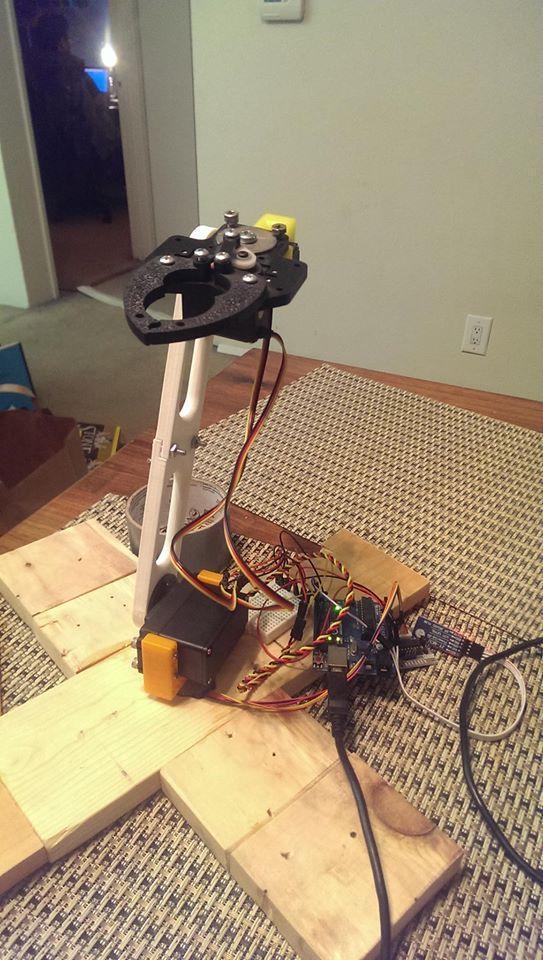
A multi-degree-of-freedom robotic arm with 3D-printed structural parts and servo actuation, driven by an Arduino over a Bluetooth link. The project covered the mechanical design and printing of the linkages and the servo control electronics.
I also wrote an Android app to control it — the phone talks to the arm over Bluetooth, letting you teleoperate each joint from a custom touchscreen interface.
Verilog · FPGA · LED Matrix · Digital Logic
A maze game implemented entirely in hardware on an FPGA, written in Verilog. I built a physical LED matrix that served as the actual display. The FPGA drove the game logic and player input handling, all as digital logic rather than software.
High Voltage · Propulsion · Physics
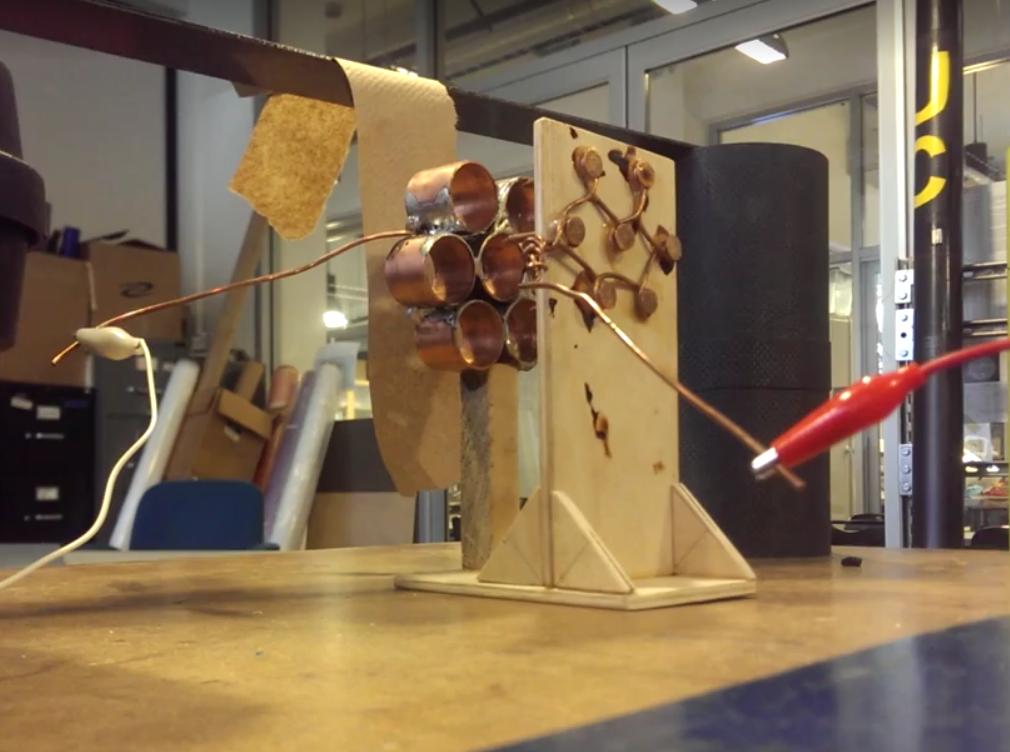
An electrohydrodynamic (ion) thruster that produces thrust from ionic wind with no moving parts. A high-voltage potential between an emitter and collector ionizes air and accelerates the ions, dragging neutral air along with them. The project explored the electrode geometry, the high-voltage supply, and the thrust-to-power tradeoffs of the effect.
Skills
C, C++, Python, Java; LabVIEW.
Rocket & real-time 3D spatial physics simulation, robotics, Physical AI.
CI/CD automation, Python packaging & release engineering, Linux, large-scale data processing.
Engineering management, technical direction, cross-functional delivery, stakeholder integration.
Contact
The best way to reach me is by email, or connect on LinkedIn.